
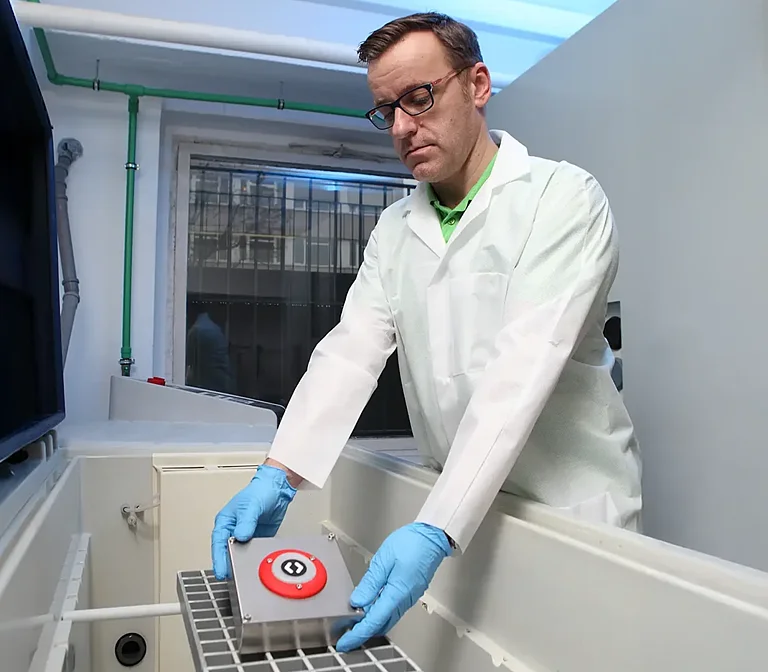
Exposure to corrosive atmospheres such as salt spray, moisture, and harmful gases—realistically simulated and evaluated in accordance with standards
Corrosion is one of the most common causes of damage to industrial products. Whether caused by moisture, salt spray, road salt, corrosive gases, or aggressive media—corrosive influences attack materials, damage or undermine coatings, penetrate enclosures, and lead to corrosion on electrical contacts or enclosure materials, thereby impairing functionality.
In AUCOTEAM’s accredited testing laboratory, we simulate corrosive effects using state-of-the-art testing technology: salt spray testing, condensation climate, harmful gases, and chemical media exposure—all in accordance with current standards such as DIN EN ISO 9227 (NSS), DIN EN IEC 60068-2-11, DIN EN IEC 60068-2-52, ASTM B117, or DIN EN ISO 6270-2.
Our corrosion tests provide insights into the durability of your products—supporting development, quality assurance, validation, series approval, or failure analysis.
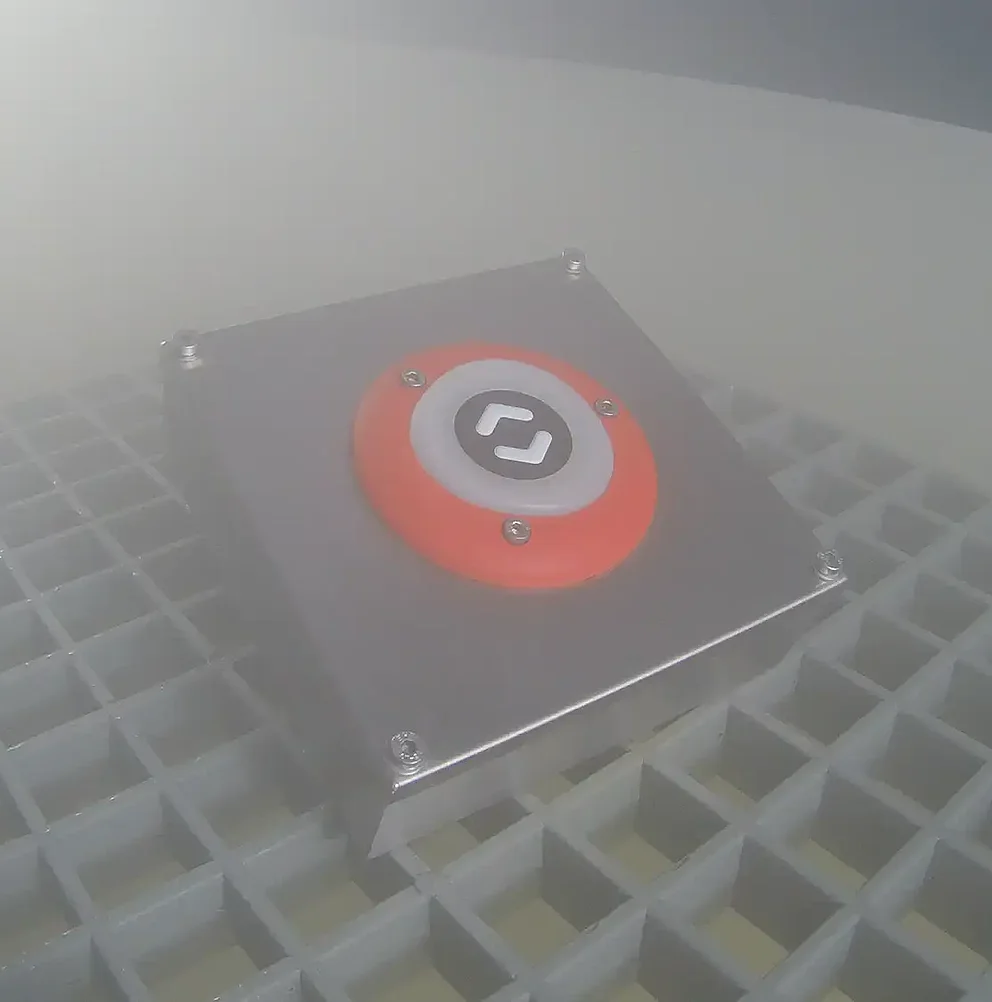
Why are corrosion tests necessary?
Many technical products must perform reliably for years in maritime environments, in production facilities, outdoors, in the air or on the road.
In these settings, materials are exposed to various corrosive agents:
- Salt spray on the coast or offshore
- Condensation caused by temperature fluctuations
- Cleaning agents, oils, solvents
- Sulfur-containing gases in industrial air
- Contact with road salt on roadways, bridges, or in parking garages
These stresses lead to surface changes, embrittlement, material failure, and electrical contact issues. Targeted corrosion testing allows for the early detection of weaknesses and the development of appropriate countermeasures—before failures occur or expensive recalls become necessary.
An overview of our corrosion testing methods
Salt spray tests
We perform static and cyclic salt spray tests as well as complex climate-corrosion alternating tests for many industries.
The most common method is the Neutral Salt Spray Test (NSS), which is often part of various cyclic corrosion tests in combination with humidity exposure.
Other methods include the Acetic Acid Salt Spray (AASS) and Copper-Accelerated Salt Spray (CASS).
These methods simulate exposure to aggressive atmospheres on components such as enclosures, coatings, screws, electronic assemblies, and connectors.
Typical damage patterns include:
- Blistering or cracking
- Coating delamination
- Perforation or crevice corrosion
- Contact failure in connectors
Condensation tests (condensation climate)
According to DIN EN ISO 6270-2, there are four distinct condensation test environments:
- Constant condensation climate (CH)
- Condensation variable climate with alternating humidity and air temperature (AHT, IC)
- Condensation variable climate with alternating air temperature (AT)
All methods simulate the condensation of air humidity on the test specimen’s surface (condensation conditions), as occurs in uninsulated outdoor installations or vehicle components.
Typical test specimens: connectors, luminaires, outdoor enclosures
Emissions tests such as the mixed-gas test (Ke) and the sulfur dioxide test (SO₂)
Corrosive gas testing provides a realistic assessment of a product’s resistance to corrosive gases in order to detect potential material and functional damage at an early stage.
In many industries, mixed-gas or single-gas tests in accordance with DIN EN 60068-2-60 (Test Ke) are required, using different concentrations of Cl₂, SO₂, H₂S, and NO₂.
Single-gas methods include the sulfur dioxide (SO₂) test in accordance with DIN EN 60068-2-42 (Test Kc) and the hydrogen sulfide (H₂S) test in accordance with DIN EN 60068-2-43 (Test Kd), as well as customer-specific tests.
Assessment of coating damage and evaluation of adhesion strength
Following a corrosion test on coated materials, coating damage is evaluated in accordance with DIN EN ISO 4628 based on the degree of rusting, blistering, cracking, flaking, chalking, and corrosion under the scratch. The adhesion of a coating is also determined using a cross-cut test in accordance with DIN EN ISO 2409.
To determine the dry film thickness, two non-destructive film thickness measurement methods are used in the AUCOTEAM testing laboratory:
- Eddy current method for non-conductive coatings on non-magnetic metallic substrates
- Magnetic method for non-magnetic coatings on magnetic base metals
Standards and Quality Assurance
Our corrosion tests are conducted in accordance with the following standards and in-house specifications:
- DIN EN ISO 9227 (NSS) – Neutral salt spray test
- DIN EN IEC 60068-2-11 (Ka) – Salt spray, constant
- DIN EN IEC 60068-2-52 (Kb) – Salt spray, cyclic
- DIN EN ISO 6270-2 (CH, AHT, AT, IC) – Condensation, constant and alternating climate
- DIN EN 60068-2-60 (Ke) – flowing mixed gas (corrosive gas)
- DIN EN 60068-2-43 (Kd) – Hydrogen sulfide (high concentration of corrosive gas)
- DIN EN 50155 – Railway applications
- DNV-CG-0339 – Marine
- DIN EN ISO 4628-2 / -3 / -4 / -5 / -6 / -8 – Evaluation of coating damage
- DIN EN ISO 4624 – Pull-off test
- DIN EN ISO 2409 – Cross-cut test
- DIN EN ISO 2808 – Determination of coating thickness
- DIN EN ISO 2178 – Measurement of coating thickness – Magnetic method
- DIN EN ISO 2360 – Measurement of coating thickness – eddy current method
- DIN EN ISO 11997-1 – Cyclic corrosion alternating test
- MIL-STD-810H – Defense (Military)
- RTCA DO160G – Aviation
- ASTM B117 – Salt spray, constant
- VDA 233-102 – Climatic-corrosion cycle test
- ISO 16750-4 – Road Vehicles – Climatic Tests
- VW 80000 (K-06, K-07, K-18) – Electrical and Electronic Components in Motor Vehicles
- VW PV 1210 – Corrosion Test
- BMW GS 95024-3-1 (K-06, K-07, K-18) – Electrical and Electronic Components in Motor Vehicles
- MBN 10306, MBN 50306, MBN 60306 (K-06, K-07, K-18) – Electrical and electronic components in passenger cars and commercial vehicles (Daimler Truck)
- CCT according to Nissan, Renault, Honda, etc. – Cyclic climate-corrosion alternating test
Industries and Fields of Application
Corrosion resistance requirements vary by industry. We test for:
Automotive & E-Mobility
e.g. body components, high-voltage connectors
Energy Industry
Outdoor distribution boxes, PV installations
Building Automation
Outdoor sensors
Railway technology
Signal technology, enclosures, cable glands
Industrial electronics
Control units, fasteners, and mounting hardware
We serve a wide range of industries—with customizable test plans and flexible equipment.
Our corrosion tests are used on a wide range of products:
- Enclosures, metal housings, paint finishes, coatings
- Connectors, screw connections, crimp contacts
- Control units, charging plugs, sensors
- Galvanized or anodized components
- Electronic assemblies in outdoor enclosures
We frequently conduct complex test programs, often in combination with material testing, mechanical testing, or leak testing.

Frequently Asked Questions
- How long will my coating withstand a salt spray test?
- Are there any electrical contact issues after exposure to SO₂?
- How does my material react to combined environmental and salt exposure?
- How quickly does visible corrosion begin?
Our tests provide you with clear answers—reliable, documented, and independent.

Customer Benefits at AUCOTEAM
- Accredited testing laboratory with state-of-the-art corrosion chambers
- Salt spray and condensation climate testing - all under one roof
- High testing capacity: parallel execution of multiple test programs
- Customized test plans for standard procedures and specific requirements
- Experienced test engineers with in-depth industry expertise
Reliable, audit-ready documentation – for certification, series approval, and analysis

Request your corrosion test now!
Would you like to assess susceptibility to corrosion, have a test report prepared, or compare products?
We will develop the right test plan—tailored to your product, your industry, and your regulatory requirements.