Product safety and mechanical stress
Products are exposed to a wide range of mechanical stresses on a daily basis—vibration in vehicles, trains, or aircraft; drops during transport; or stresses in industrial environments.
Using vibration, shock, and drop tests, as well as compression/tensile and IK tests, we evaluate the performance and durability of your products throughout their entire lifecycle.
Our services are tailored to customers in the automotive industry, railway, engineering, maritime/shipping, defence/military, aeronautical/space, mechanical and plant engineering, and other industrial sectors.
The procedures are based on IEC 60068-2, IEC 61373, ISO 16750-3 as well as other relevant standards and customer-specific requirements.
Insights into our mechanical testing
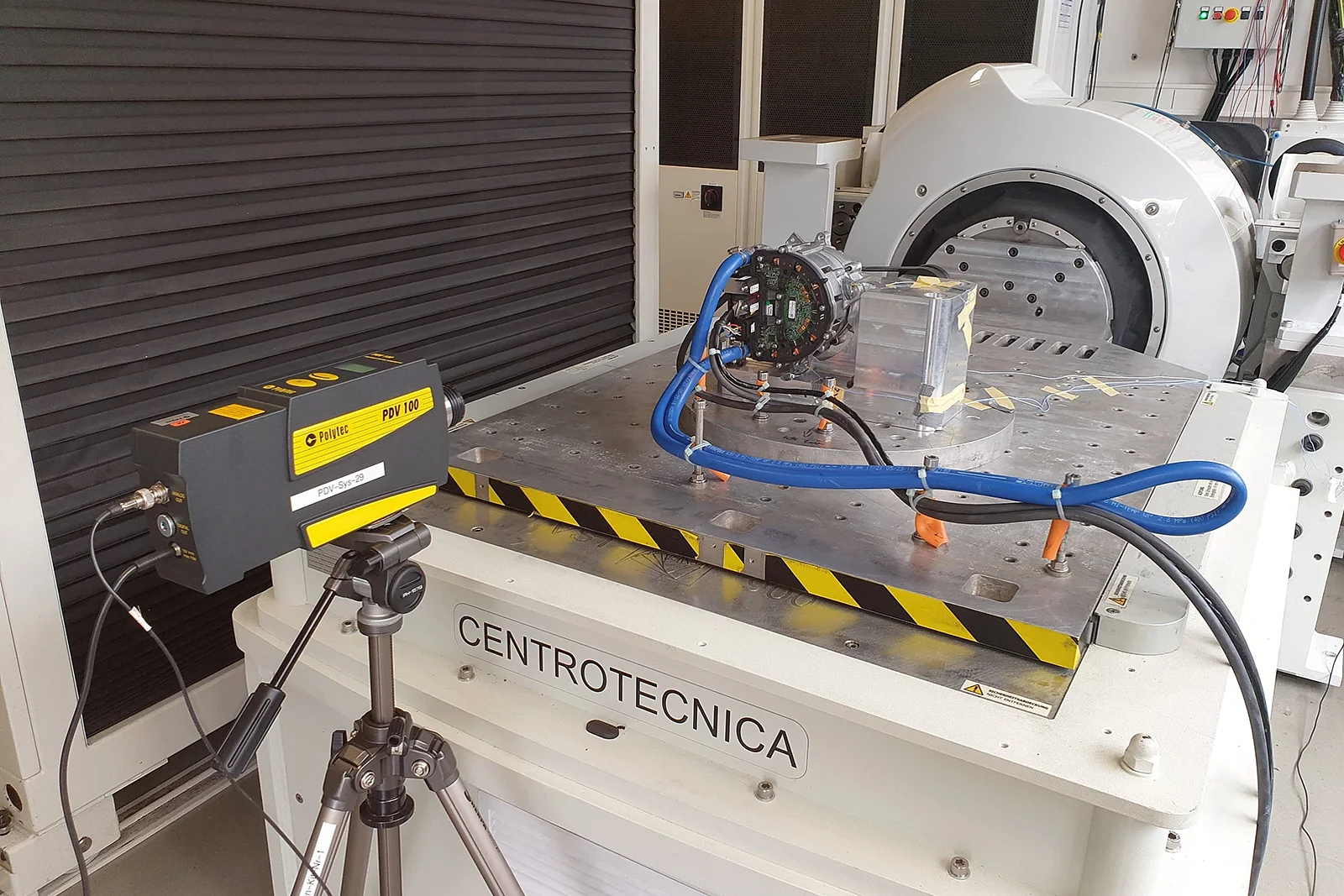
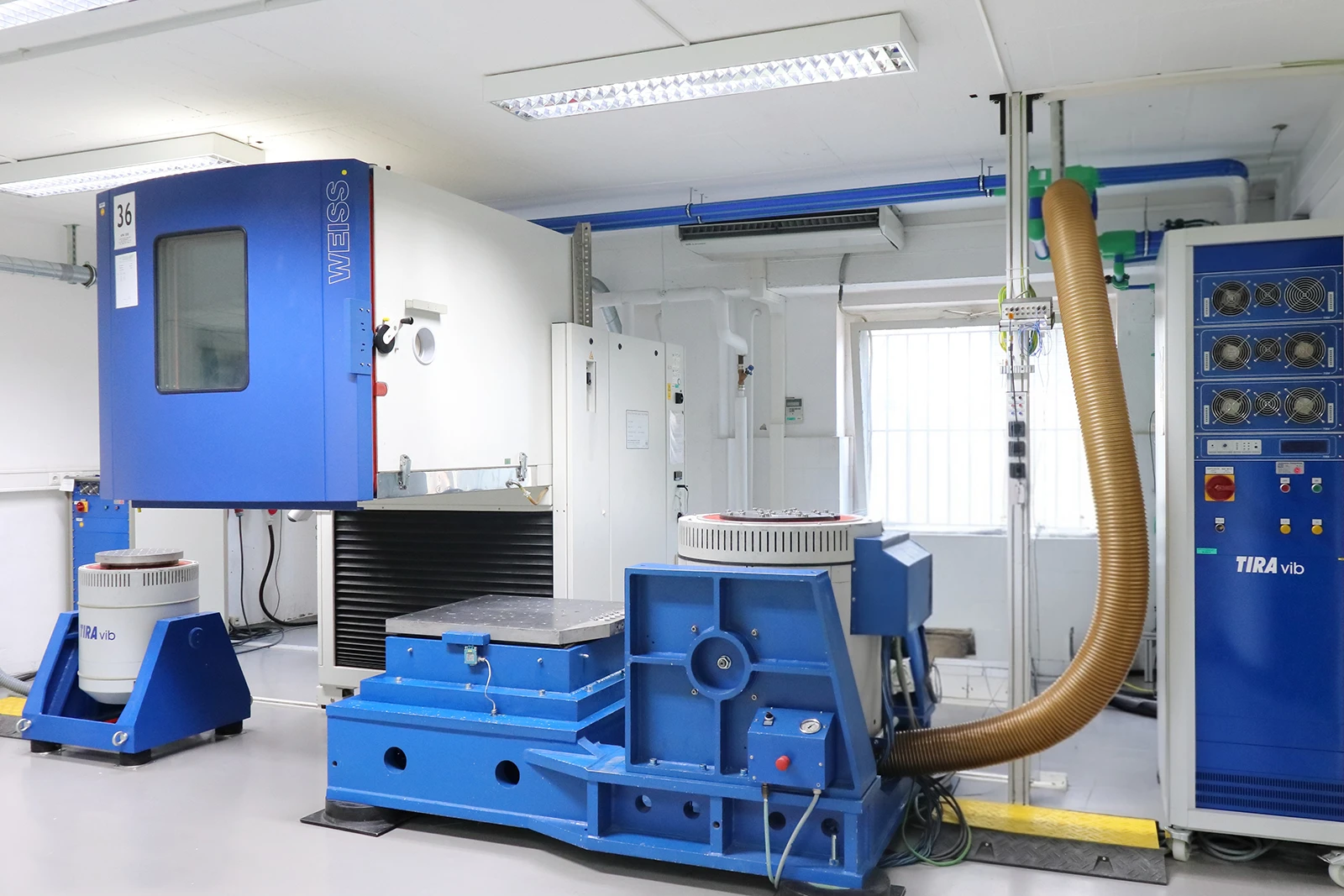
Our mechanical-dynamic testing methods and technologies
You benefit from our many years of experience and state-of-the-art testing technology.
From drop tests and compression/tensile tests to vibration and shock tests, as well as climate-controlled mixed-mode vibration tests, we cover all relevant testing methods.
We would be happy to advise you on test procedures and the design of an optimal vibration isolation system.
Mechanical shock
In mechanical shock testing, test specimens are subjected to a mechanical impulse characterized by high acceleration and a short duration (milliseconds).
This simulates events such as the dropping of objects or packaging, driving over curbs, collisions, shunting impacts in rail transport, or pyrotechnic separation in spaceflight.
- The tests are based on IEC 60068-2-27 and are conducted, depending on the event, as:
- a single shock with up to 10 shocks per spatial direction (for rare events) or
- a continuous shock with up to 100.000 shocks per direction (for frequent events such as car doors slamming).
- Typical shock waveforms include:
- Half-sine shock
- Sawtooth shock
- Trapezoidal/square shock
- Simulation is performed
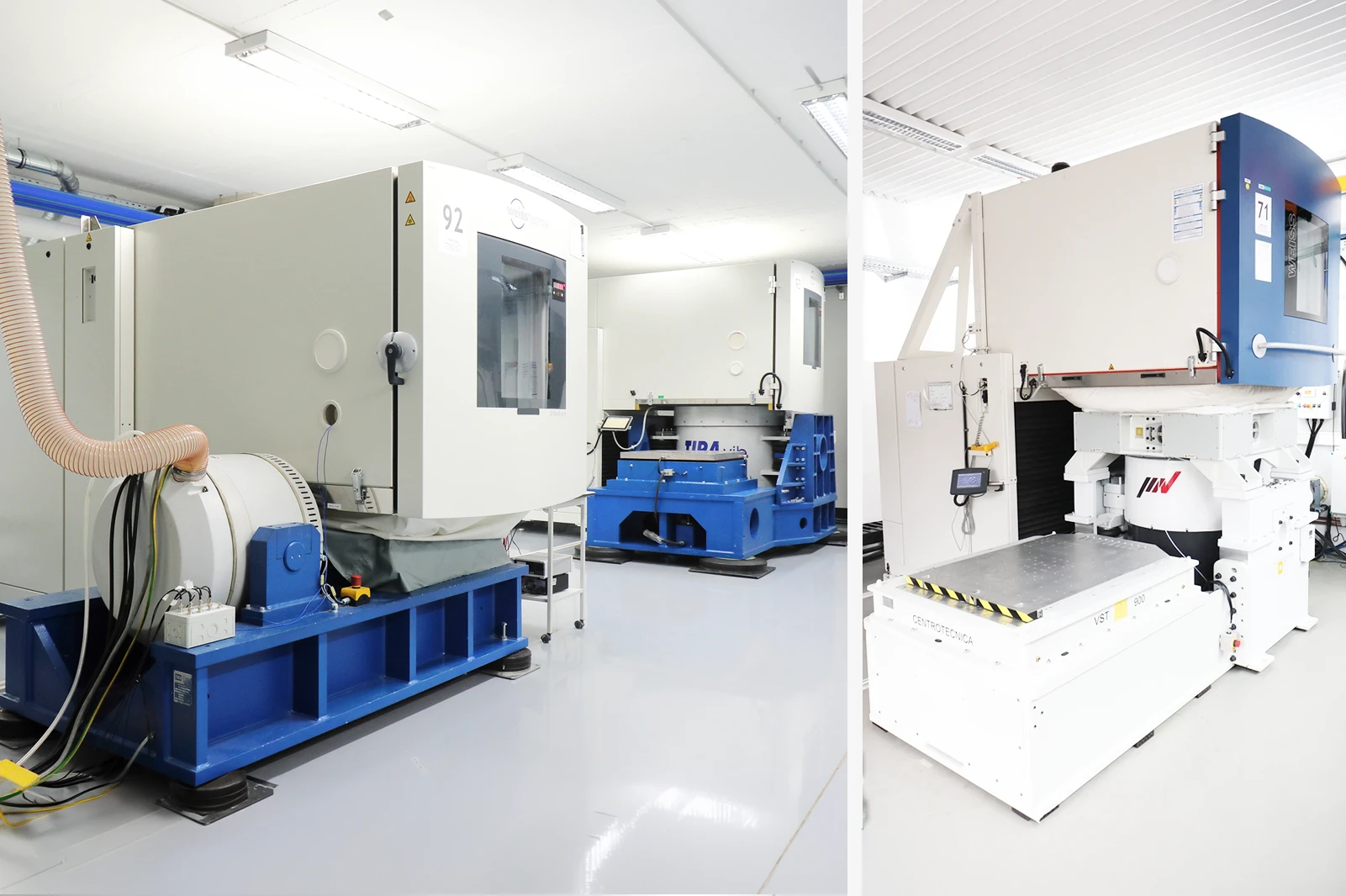
- up to 150 g using electrodynamic vibration test systems (shakers)
- up to 800 g using a shock table
- up to 5.000 g using a drop test apparatus
Vibration testing
In vibration testing, test specimens are subjected to vibrational stress in order to identify weaknesses such as cracks, abrasion, deformation, and material failure, and to verify their stability over their intended service life.
These tests are used in the automotive, rail, aerospace (e. g., launch phase), maritime, electronics, and packaging industries.
The test is conducted in three spatial axes at frequencies up to 3,000 Hz and accelerations up to 80 g.
- Typical profiles:
- Sinusoidal vibration (IEC 60068-2-6) – for simulating, e. g., rotating machinery, earthquakes, and acoustic sound waves
- Broadband noise (IEC 60068-2-64) – for simulating, e. g., uneven road surfaces, railroad tracks, and aerodynamic forces
- Mixed-mode (IEC 60068-2-80) – combined test methods using sinusoidal vibration and broadband noise to realistically simulate operating conditions
- SoR: Sine on Random
- RoR: Random on Random
- SoRoR: Sine on Random on Random
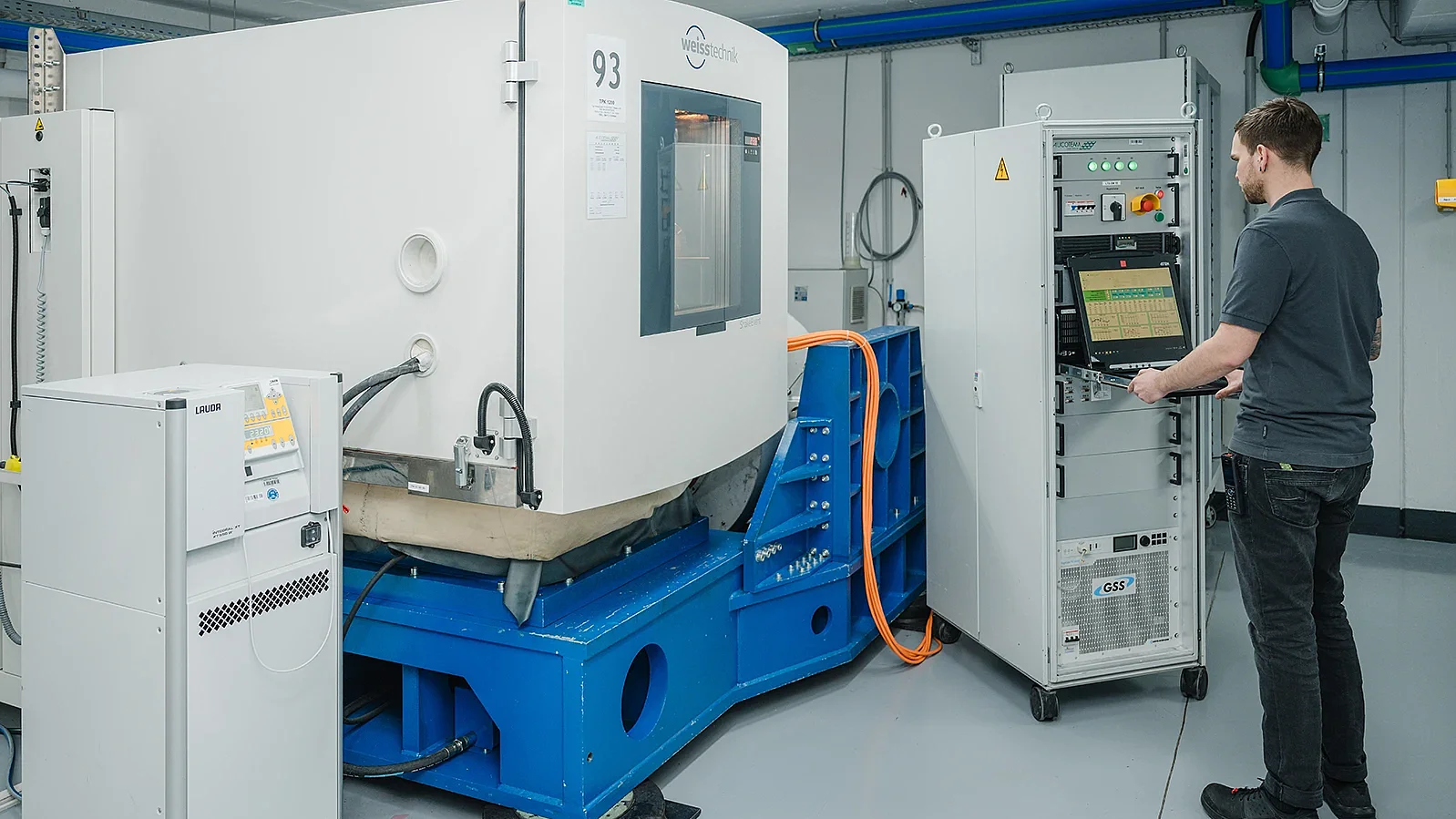
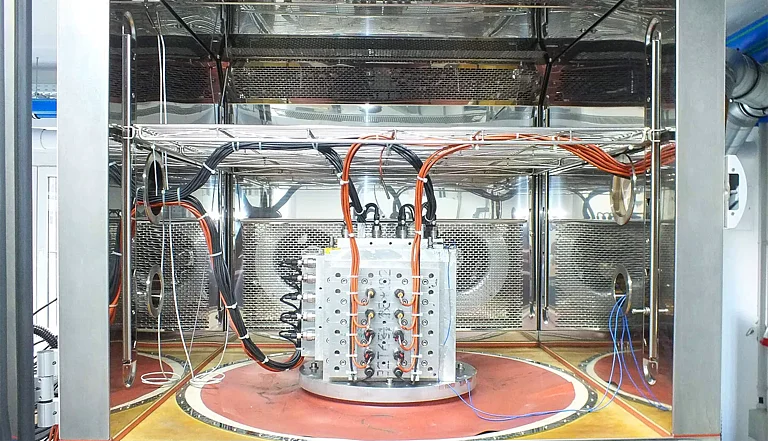
Combined mechanical tests including temperature, climate, and performance
The mechanical shock and vibration tests are additionally combined with fluctuating extreme temperatures and/or humidity in order to evaluate all conceivable material properties, such as
- Temperature change (soft / brittle)
- Moisture (soft / swollen)
to test and thereby activate realistic failure mechanisms.
These tests are used particularly in the automotive sector, as well as in the fields of power machinery and agricultural machinery.
Typical test parameters include:
- Temperature: -50 °C to +180 °C
- Humidity: up to 95 % RH
Resonance Measurement / Resonance Analysis
Resonance measurement/resonance analysis involves analyzing the vibration behavior of components and determining natural frequencies or resonance points within defined frequency ranges.
Using miniature accelerometers and optical measurement technology (laser vibrometers), resonances can be detected anywhere.
The measurements are performed on electrodynamic vibration test systems (shakers) and are also used to evaluate the clamping device (low resonance) as well as changes in resonance following long-term vibration exposure.
Control and monitoring of test specimens
Test specimens can be controlled using high currents, high voltages (HV), as well as cooling water, oil, compressed air, and other media.
It is possible to communicate with various bus systems and to measure all electrical and physical parameters.
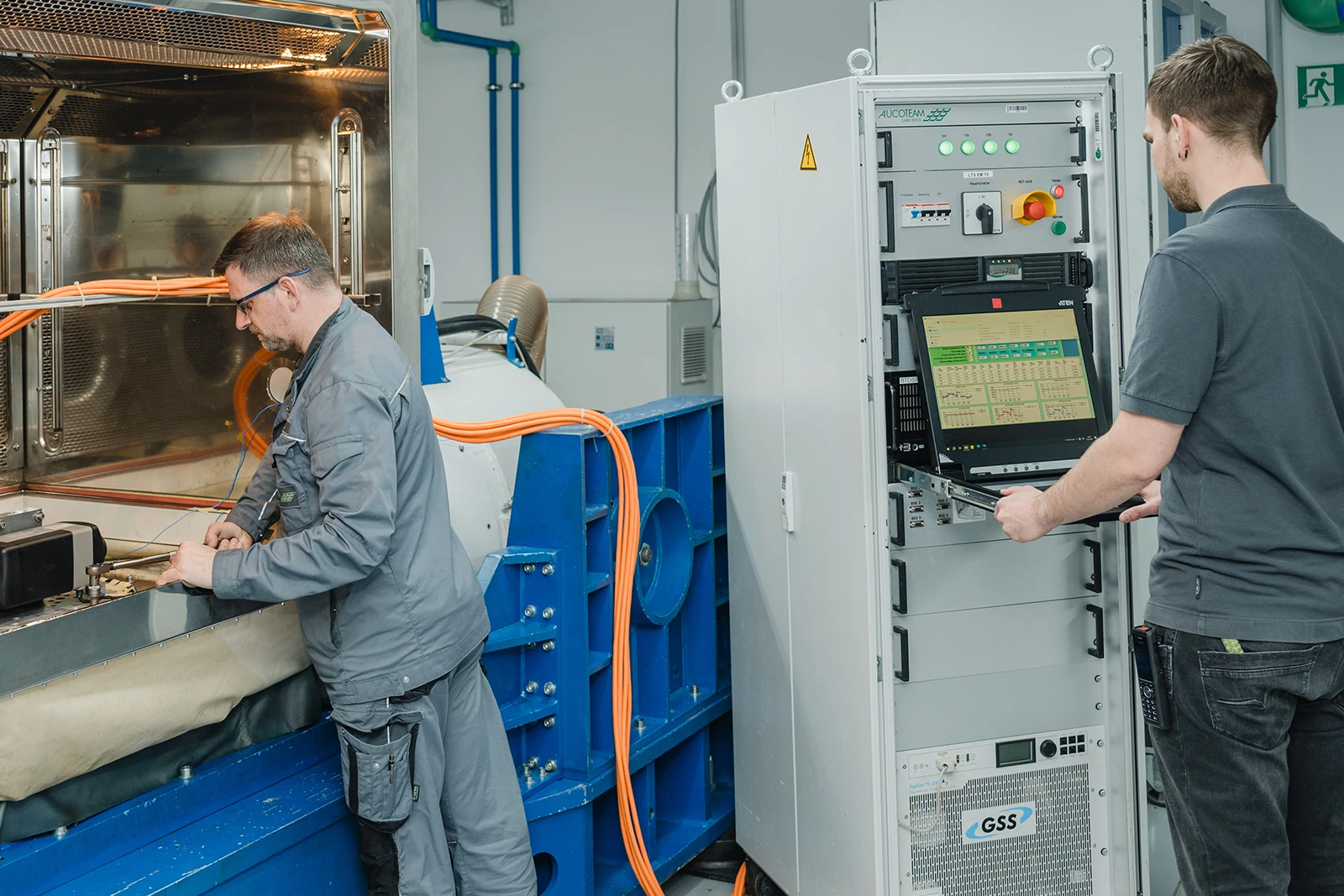
Heart of Test – our test racks for complex components
Our „Heart of Test“ modular test racks provide a platform for validating complex components with high-voltage (HV) and low-voltage (LV) power supplies, safety functions, and bus interfaces (CAN, LIN, SENT). The system can be combined with and expanded to include external devices such as climate chambers, fluid conditioners, and more.
Benefits for customers:
- Quick start to testing
- Cost-effective through reuse and rental
- No in-house development required
Drop test
Drop tests simulate falls and impacts that a product may experience during transport, handling, or assembly. In our test laboratory, we conduct single and repeated drop tests on components such as control units, displays, handheld devices, packaging, or other sensitive assemblies.
We evaluate structural damage and functional performance after the drop. The tests are conducted in accordance with IEC 60068-2-31 and customer-specific requirements.
IK Test (Impact Test)
IK tests are used to verify the impact and shock resistance of devices and enclosures. The impact energy of standardized hammers simulates real-world use.
Standards and Quality Assurance
All mechanical test procedures are conducted in accordance with current standards, including:
- IEC 60068-2-6 – Test Fc: Sinusoidal vibration
- IEC 60068-2-27 – Test Ea: Shock
- IEC 60068-2-53 – Combined climatic and dynamic tests
- IEC 60068-2-64 – Test Fh: Vibration, broadband noise
- IEC 60068-2-80 – Test Fi: Mixed-mode vibration test
- DIN EN 61373 – Tests for railway applications
- ISO 16750-3, VW 80000, BMW GS 95024-3-1, SAE USCAR – Automotive factory standards
- John Deere JDQ, Claas CN – Requirements for agricultural machinery
- RTCA DO-160G – Aerospace requirements
- MIL-STD-202 / MIL-STD-810 / MIL-STD-883 – Military sector
- Germanischer Lloyd, DNV GL – Marine / Shipping
- ISTA – Transport and packaging
- LV 214 – Testing of high-voltage connectors
The tests are conducted using:
- Documentation of test specimens, test setup, representation of test axes, and identification of measuring and testing equipment
- Presentation of all measured values as well as shock and vibration test reports
- Informative photographic documentation
- Evaluation according to standards or individually defined limit values
As an accredited testing laboratory (DIN EN ISO/IEC 17025), we provide you with globally recognized test reports.
- In digital format
- With detailed photographic documentation
- Recognized by official authorities
Industries and Application Areas
Mechanical testing has a wide range of applications.
The test specimens are typically enclosures (metal, plastic), printed circuit boards, connectors, relays, or assemblies containing sensitive components. Typical industries and applications include:
Industrial Electronics & Automation Technology
Testing of actuators, control units, and fasteners for manufacturing systems, control cabinets, or robotics.
Railway Technology
Enclosures, displays, and control units for use on rail vehicles or at railway facilities.
Smart Building & Building Automation
Testing for drop resistance, impact resistance, and vibration resistance of control elements, lighting technology, and control systems.
Automotive & E-Mobility
Testing of high-voltage connectors, vehicle electrical system components, and vehicle sensors for mechanical stress during operation.
Energy Technology & Infrastructure
Mechanical durability testing of distribution cabinets, PV components, connectors, and outdoor enclosures.
Medical Technology & Laboratory Technology
Simulation of transport stresses on sensitive devices, housing protection against impact or drops – e.g. for mobile analytical devices.

Your benefits with AUCOTEAM
AUCOTEAM offers a combination of experience, technical expertise, and standards-compliant documentation—tailored to your needs, solution-oriented, and industry-specific.
- State-of-the-art test benches for shock, vibration, and oscillation
- Tests according to EN, ISO, and IEC standards
- Shaker tests with climate chamber integration possible
- In-house test automation for custom setups
- Test bench development for special applications
- Short lead times & transparent consulting

Request a mechanical test now!
Would you like to have your products tested to their limits with mechanical testing?
Whether it is vibration testing according to standards, a customized impact test, or a combined test—we will provide personalized advice and work with you to develop the right test plan.