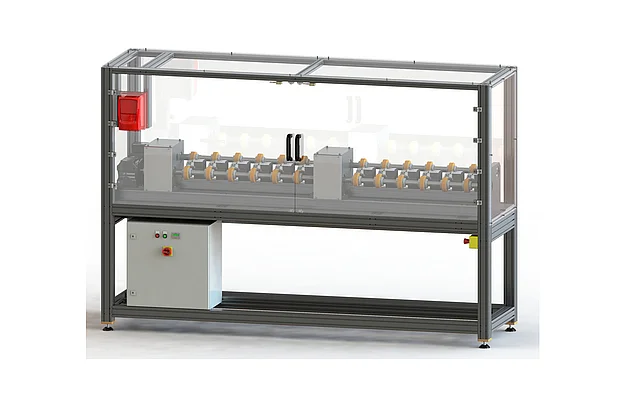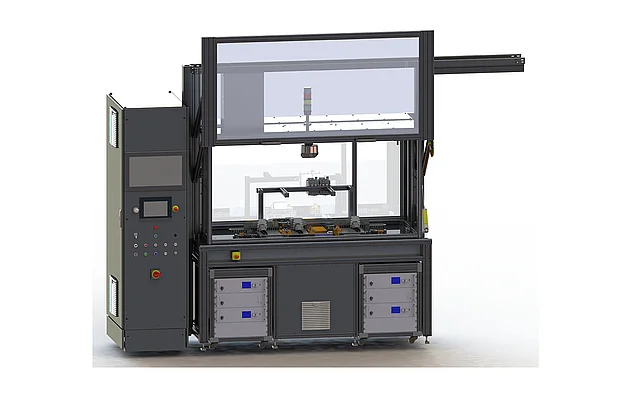
OSRAM, one of the world’s two leading lighting manufacturers, is a key customer of AUCOTEAM GmbH. For more than 20 years, AUCOTEAM engineers have been successfully developing automation solutions for the company. The test rig delivered supports the manufacturer in ensuring the quality of its P-VIP projection lamps.
P-VIP lamps are high-pressure mercury lamps designed for use in video projectors, projection televisions and other projection applications. They offer high luminous efficacy and are characterized by a long service life with minimal loss of luminous flux. It takes a great deal of experience to develop and produce lamps of this quality. OSRAM is an expert in this field.
The Task
To ensure long service life and high luminous efficacy, the lamps must undergo a defined burn-in process. AUCOTEAM GmbH has developed a specialized burn-in stand for this purpose. On this burn-in stand, the lamps are burned in under the required parameters, and the measured values for current and voltage are recorded. Data from the electronic ballast (EB) is transmitted to the control system via a data interface and stored in a database. The lamp itself must be cooled in a defined manner during the burn-in process and any mutual influence between multiple lamps must be ruled out. The test bench allows for the simultaneous processing of 40 lamps.
The Structure
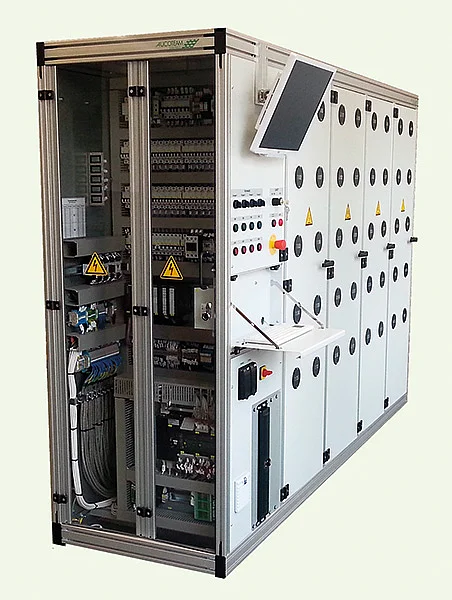
The UART-40 test rig has a total of 40 lamp chambers, arranged in 5 rows and 8 columns. Each lamp chamber measures 200 x 200 x 200 mm. One lamp is fired and tested per lamp chamber. The lamp is mounted in a lamp holder and supplied with electrical power via a corresponding electronic ballast. The electronic ballasts are installed individually on interchangeable ballast modules and can be quickly adjusted or replaced as needed. The technological control of the lamps (burning, cooling, post-cooling etc.) is carried out in groups of 10 (arranged in burn-off shafts in 2 columns of 5 rows each). The firing station is controlled via an IPC, PLC and UART system (SORCUS components with corresponding software). Each lamp chamber is equipped with a fan controlled by the PLC (e.g. with program-dependent switch-on and switch-off delays, speed control). Fan speed control is performed row by row via the PLC. The control cabinet for the combustion stand is integrated into the combustion stand frame.