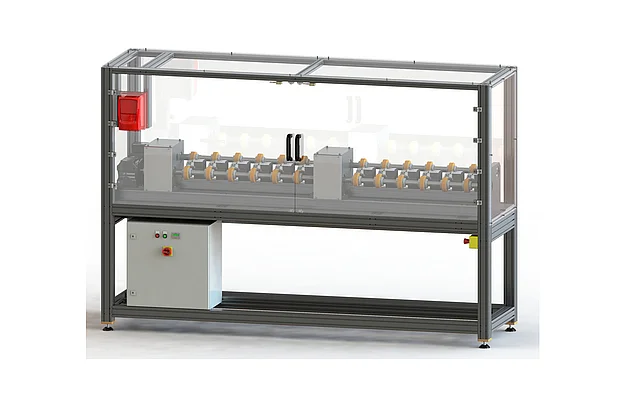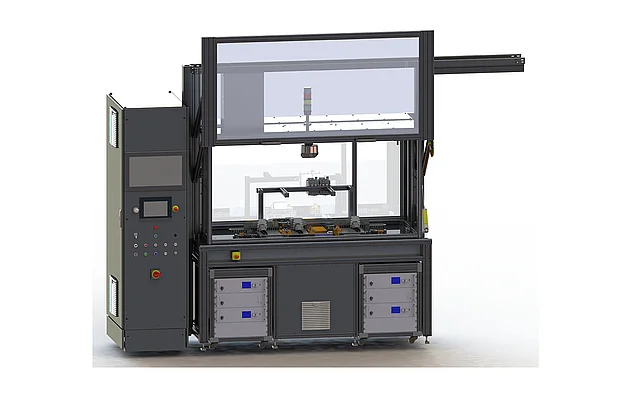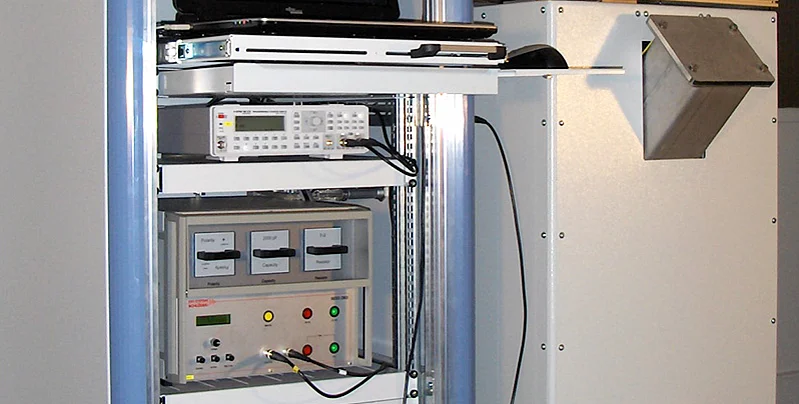
Continuing its successful collaboration with the Explosives Division of the Federal Institute for Materials Research and Testing (BAM), AUCOTEAM was commissioned to develop and build another facility for testing electric detonators for civilian explosives. It is intended to verify the safety of the detonators against electrostatic discharges. The European standard EN 13763-13 requires the reproducible generation of a defined electrical discharge across the test specimen, as well as the metrological logging and monitoring of the tests. To achieve this, capacitances of up to 10 nF must be charged to voltages of up to 30 kV and discharged in a controlled manner through the test specimen. The test criterion is a defined current pulse that the respective detonator type must withstand. This value must be measured, calculated and recorded.
Tests for protection against electrostatic discharge
The European standard EN 13763-13 requires the reproducible generation of a defined electrical discharge through the test specimen, as well as the metrological recording and monitoring of the tests. To this end, capacitances of up to 10 nF must be charged to voltages of up to 30 kV and discharged in a controlled manner through the test specimen. The test criterion is a defined current pulse that the respective igniter type must withstand. This value must be measured, calculated and recorded.
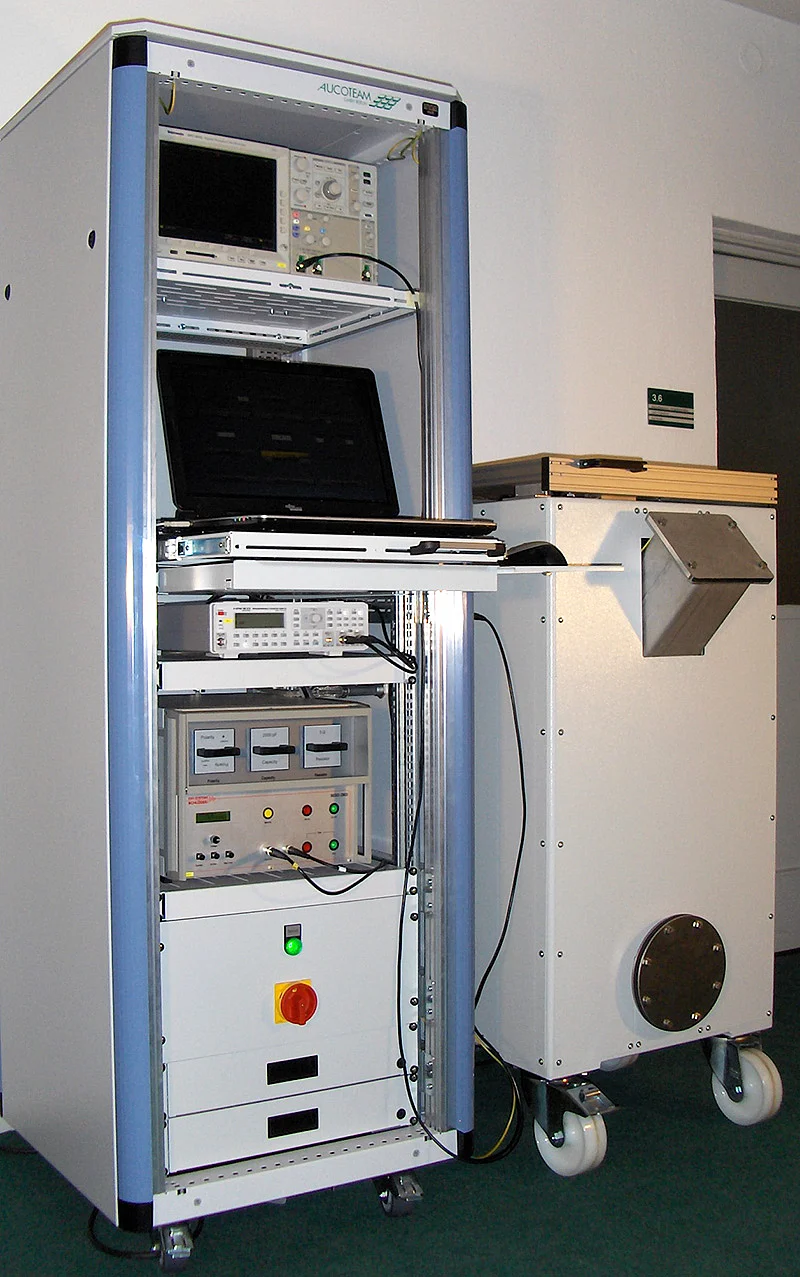
A test rig (photo) was designed that incorporates a pulse source, measurement equipment and a user interface. The test specimen is housed in a separate stainless-steel container, whose fittings meet the safety requirements for high-voltage test stations and provide the necessary explosion protection.
A controller-driven ESD pulse source generates the discharge energy. The control of the automatic test sequence was implemented using LabVIEW software, taking all safety devices into account.
Recording the discharge pulses by measuring the discharge current with a specially manufactured inductive current probe was technically challenging. This allows peak values of up to 5,000 amperes to be recorded with a resolution of 0.1 volts/ampere at a bandwidth of 20 MHz and signals with pulse rise times in the nanosecond range to be measured. The current pulses are recorded using a storage oscilloscope, which is also controlled via the LabVIEW software.
A high-speed light sensor in the ignition chamber detects the firing of the test specimen via a flash of light. This fulfills the requirements of the standard for measuring the reaction or delay time of the igniters over a 6-second period following exposure to the ESD pulse. Because an oscilloscope cannot be used for this time measurement due to the highly variable time bases, it was implemented using a synchronized electronic counter, which is also configured and controlled via LabVIEW.
The user interface is a notebook connected to the test rig’s devices via USB and RS232 interfaces and to the safety-critical hardware via a digital I/O module.
The use of LabVIEW 8 made it possible to meet the client’s requirements for simple and easy-to-learn graphical software. The user interface supports standardized test procedures and automates them to the greatest extent possible. Test conditions and measurement results are logged and stored in BAM-specific test reports. The stored results can be output in tabular and graphical formats.
This concept allows for the advantageous expansion of the test setup or adaptation to special test conditions.
The project team would like to thank Dr.-Ing. Holger Krebs for his excellent collaboration, as he supported the project with significant design suggestions.