Compression Tests / Tensile Tests for load measurement or as stress tests
Can a new material, an improved adhesive bond, a welded joint or a perfectly designed component withstand the mechanical stresses (static/dynamic) of actual use?
Whether cable connections (crimp or plug connections), enclosures, or latching mechanisms: The ability to withstand compressive and tensile loads determines whether a product will function reliably.
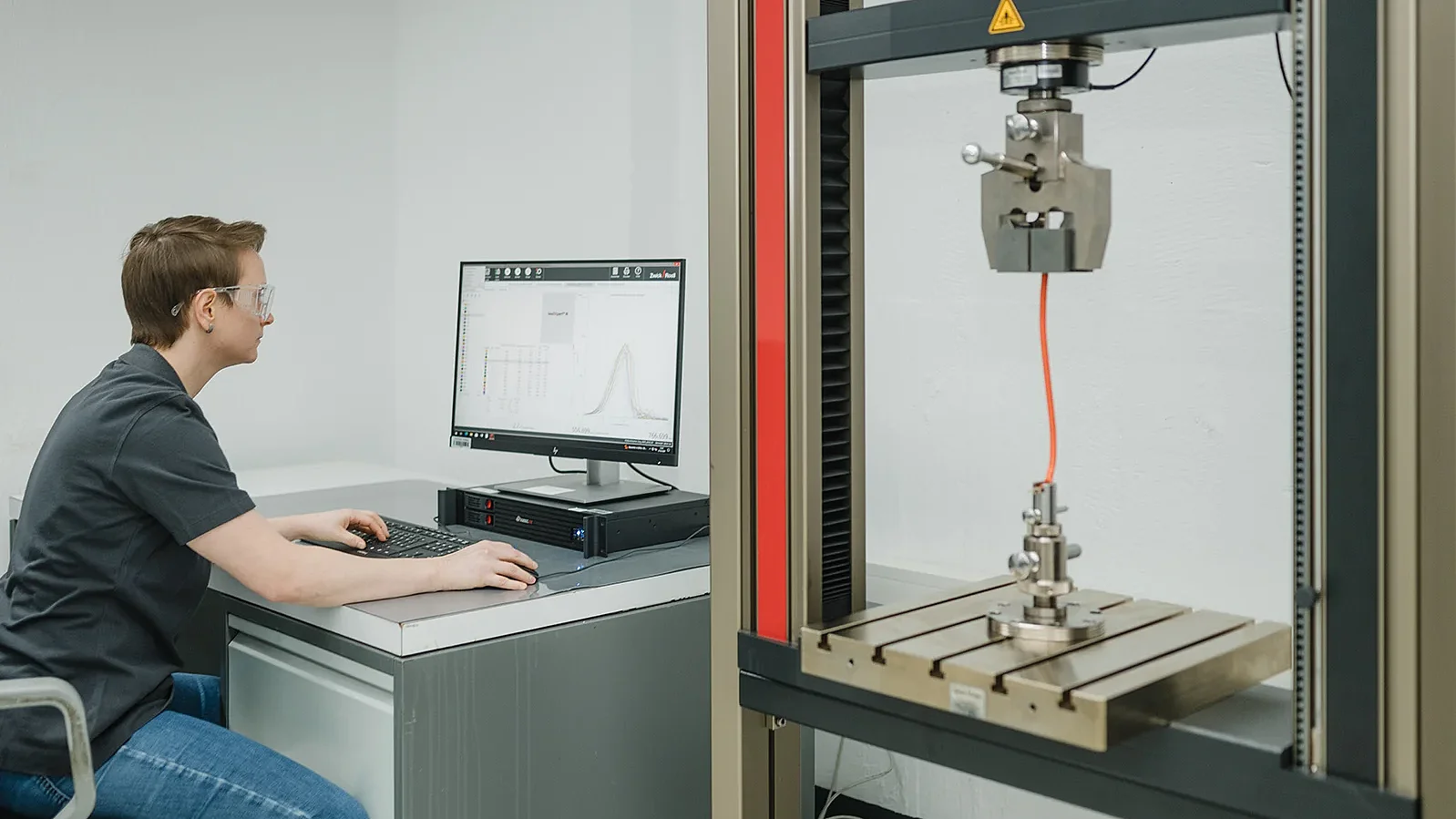
We use accredited testing methods to evaluate how components behave under realistic tensile and compressive loads—from pin-push testing to complex enclosure tests. We systematically push components to their load limits and determine results such as:
- Force-displacement diagrams,
- findings on material deformation,
- information on fracture behavior
- the breaking force
- the latching force.
You will gain the following insights:
- Where are the load limits?
- Are there any potential material weaknesses?
- And what stress can materials withstand during long-term use?
Our testing experts use calibrated test rigs to measure data and create force-displacement diagrams to assess the mechanical quality of your products. The data is documented in a reproducible and reliable manner. This allows us to deliver robust results for development, quality assurance and series production approval—before any critical situations arise in real life.
Testing Methods and Technologies – What We Test Is Built to Last
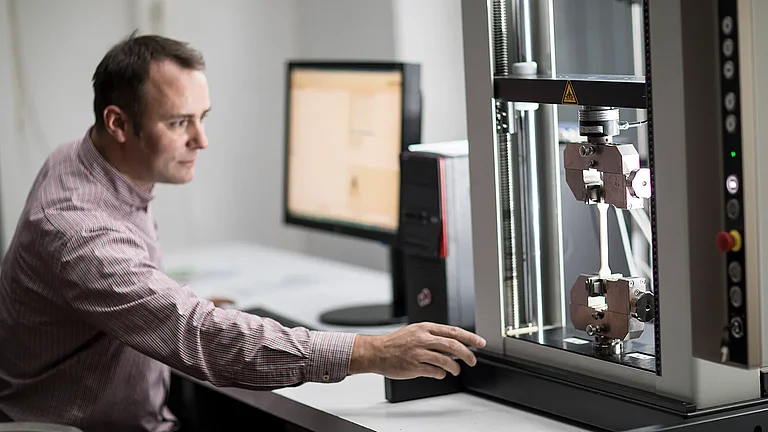
Our universal testing machines can simulate a wide range of mechanical stress scenarios—precisely tailored to your components, standards and application requirements.
An overview of typical testing tasks:
Plug engagement force
Determining the force required to push a connector all the way in until it clicks securely into place
Plug locking force
Pull test on a connector or cable with the connector locked in place – Evaluation of the mechanical retention force
Plug insertion force
Testing the force applied to a mated connector after it has engaged
Pulling force required
Determining the force required to release the plug when the latch is open
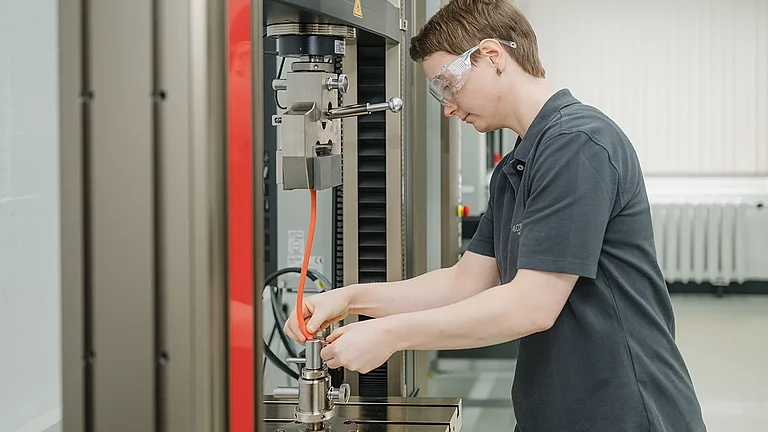
Cable pull test
Axial tension on cable strands or wiring systems – also available in multi-axial configurations, e.g. for high-voltage cable harnesses
Pin Push-Pull Test
Compression/tension loading applied directly to the pins—until they are pushed in or pulled out, including a force-displacement diagram
Housing stability
Forces acting on housing components, such as pressure on connection areas, covers or locking tabs
Technical Specifications:
- Zwick/Roell universal testing machines (up to 20 kN)
- Force- and position-controlled testing
- Test speed: 0.001 – 1,500 mm/min
- Digital evaluation via force-displacement diagrams
- Combination with temperature, climate, or vibration pre-loading possible
Example test parameters:
- Pin Push: Indentation force on contact pins (with hysteresis measurement)
- Cyclic connector testing: axial mating and disconnection with contact monitoring (synchronized with force and displacement)
- Crimp connections: Testing of cable pull-out forces (can be combined with climatic pre-loading (climatic tests))
Typical Industries & Applications
We flexibly adapt our tests to specific product geometries, materials and operating conditions—even in combination with other types of loading.
Our compression/tensile testing methods are in demand for:
Automotive & E-Mobility
Connectors, crimp terminals, latches
Railway technology
Controls, housing, locking tabs
Building Automation / Smart Home
Plug-in modules, mounting rail components
Industrial electronics
PCB connections, contact modules
Medical Technology & Laboratory Technology
modular interfaces, mating cycles
Standards and Quality Assurance
Our compression and tensile tests are conducted in accordance with the following standards and in-house specifications:
- ISO 527 - Plastics – Determination of tensile properties
- ISO 604 - Plastics – Determination of compressive properties
- VW 80106 - Automotive – Plug connections to and within electrical and electronic components
- LV 214 Automotive – Connectors
- Customer-specific specifications
The tests are performed using:
- Documentation of the test specimens, the test setup and the measuring and testing equipment
- Presentation of force-displacement diagrams and other measured values
- Data on peak forces, elongation behavior, recovery values or breaking force, tear behavior and latching force
- Meaningful photographic documentation
- Evaluation according to standards or individually defined limit values
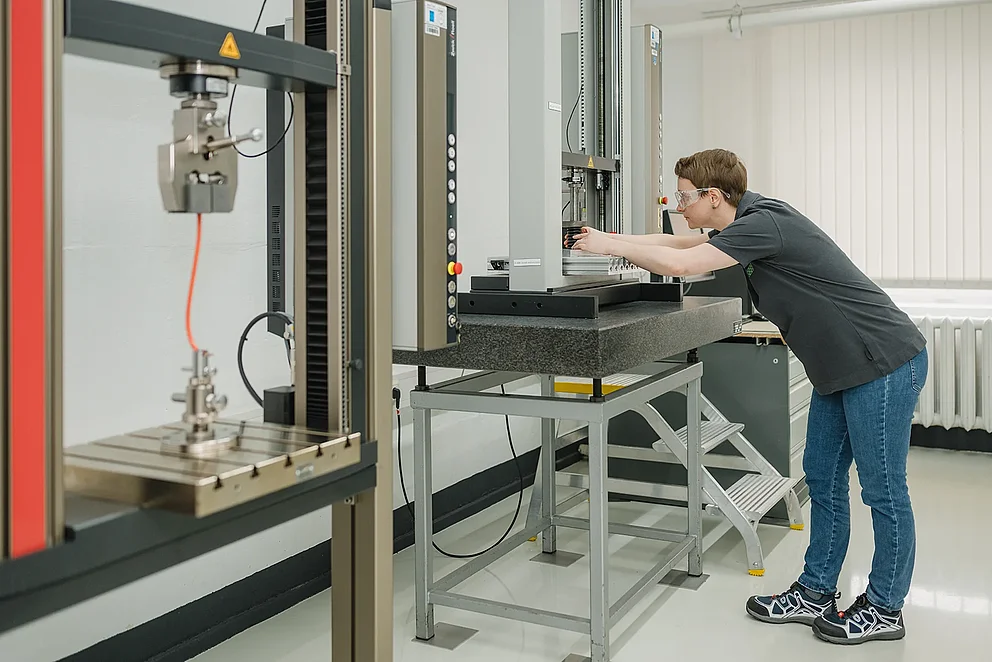
Focus on the Automotive Industry – Vehicle Safety Starts in the Test Lab
In the automotive sector in particular, connectors, housings and fasteners are subject to a wide range of mechanical stresses—vibration, temperature fluctuations or assembly processes. Our compression tests / tensile tests cover typical scenarios in e-mobility, electronics development, high-voltage system engineering and sensor integration.
Typical test tasks:
- HV connector testing: retention force, pin strength, stability under transverse forces
- Wiring harness testing: Single and multiple tensile testing on strands, connectors and latches
- Fuse units / modules: Compression testing of latches
Combination with environmental simulations:
We also test after a wide variety of preconditioning procedures to simulate realistic stress conditions—including climate, corrosion or vibration pre-loading.

Customer Benefits at AUCOTEAM
- Two powerful universal testing machines (up to 20 kN)
- Precise control of tensile and compressive force, position- or force-controlled
- Pin push, housing test, latching force test
- Repeatable cycle testing (with synchronized contact monitoring)
- Analysis with force-displacement diagram
- Temperature and climate pre-treatment can be integrated
- Personal consultation by experienced test engineers

Request your mechanical testing now—for compression, tensile strength and safety!
Whether it’s a snap-fit connection, a connector, a housing component or a wiring harness component: Our push-pull tests provide you with clear insights into the durability, functionality and safety of your products—all in accordance with standards, specifications and industry-specific requirements.